
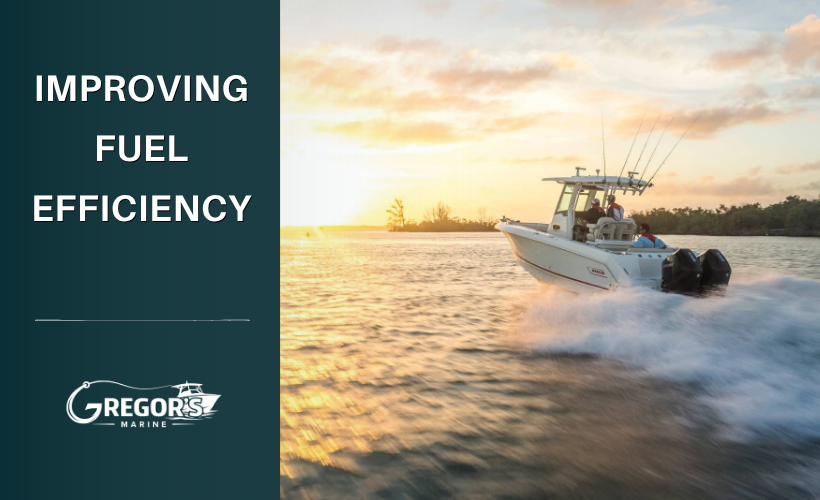
7 Ways to Improve Your Boat's Fuel Efficiency
7 Ways to Improve Your Boat's Fuel Efficiency
Fuel economy is something every boat owner cares about, especially with today's fuel prices. Many people assume poor fuel efficiency means there is something wrong with the engine, but that is not always the case.
In reality, fuel consumption is affected by dozens of factors, including propeller selection, engine trim, boat weight, maintenance, and even how the boat is loaded. Small changes in setup, maintenance, and operating habits can make a noticeable difference over time. Understanding how your boat performs and why your engine burns fuel the way it does can help you spend less time at the fuel dock and more time enjoying your time on the water.

1. Your Propeller Controls More Than Speed
Many boat owners choose a propeller based only on top speed. In reality, the propeller largely determines how efficiently the engine operates.
If the propeller prevents the engine from reaching its recommended RPM range, the engine may work harder while burning more fuel. The fastest prop is not always the most efficient prop.
2. Most Boats Are Over-Propped
As boats gain:
- trolling motors
- batteries
- power poles
- electronics
- additional gear
they become heavier. The propeller that worked perfectly five years ago may no longer be ideal today. Many boats that struggle to reach proper RPM are simply over-propped.
3. Hull Growth Starts Hurting Fuel Economy Quickly
It does not take heavy barnacle growth to affect performance. Even light slime on the hull creates drag. The engine compensates by producing more power, which means more fuel consumption. A clean hull often improves both speed and fuel economy.
4. Most Engines Are Most Efficient Below Wide Open Throttle
Many Mercury engines achieve their best fuel economy at moderate cruising speeds. Sometimes reducing speed by only a few hundred RPM can dramatically reduce fuel consumption while only slightly affecting travel time. Modern engine monitoring systems make this much easier to identify.
5. Engine Trim Is Often Overlooked
Improper trim changes the angle at which the hull travels through the water. Too much positive trim can increase drag. Too little trim can force the bow down and create additional resistance. Learning proper trim often provides immediate improvements.
6. Small Maintenance Problems Add Up
A partially restricted fuel filter or worn spark plugs may not create obvious performance issues, but they can reduce efficiency over time. Many fuel economy complaints are solved during routine maintenance.
7. Weight Distribution Matters
Where weight sits on the boat can be just as important as how much weight is onboard. Moving coolers, batteries, or gear can sometimes improve running attitude and reduce fuel consumption.
For example, if too much weight is concentrated at the stern, the bow may ride higher than intended. This increases hull drag and can make it more difficult for the boat to get on plane. On the other hand, excessive weight in the bow can cause the boat to plow through the water rather than ride efficiently on top of it.
Final Thoughts
Fuel economy is rarely controlled by a single factor. Small improvements in setup, maintenance, and operation often combine to produce noticeable results.
Understanding how your boat performs allows you to make adjustments that save fuel while improving the overall experience on the water.
Frequently Asked Questions
Does adding accessories affect fuel economy?
Yes. Additional weight and drag can change how efficiently the boat performs.
Is top speed the best way to evaluate a propeller?
No. Proper RPM, acceleration, handling, and fuel economy all matter.
Does a dirty fuel filter affect efficiency?
It can. Fuel restrictions may force the engine to work harder and reduce performance.
Recent Posts
-
The Boat Owner's Buy Once, Cry Once Guide: Upgrades Worth Paying More For
The Boat Owner's Buy Once, Cry Once Guide: Upgrades Worth Paying More For Most boat owners have hear …Aug 6th 2026 -
Milky Lower Unit Oil: What It Means and What to Do Next
Draining your lower unit oil is one of the simplest ways to check the health of your gearcase. If th …Jul 28th 2026 -
Hurricane Preparation for Boat Owners: How to Protect Your Boat Before the Storm
For boat owners, hurricane season means more than stocking up on supplies. A little preparation befo …Jul 28th 2026